第八章 对象、类和面向对象编程 对象 对象的属性 数据属性 1 2 3 4 5 6 7 let person = {};Object .defineProperty (person, "name" , {configurable : true , enumerable : true , writable : true , value : "test"
访问器属性 1 2 3 4 5 6 7 8 9 10 11 let person = {};Object .defineProperty (person, "name" , {configurable : true , enumerable : true , get (return "test" ;set (newValue ) {
Object.defineProperty
Object.getOwnPropertyDescriptor 1 2 3 4 5 6 7 8 let descriptor = Object .getOwnPropertyDescriptor (person, "name" );console .log (descriptor);
Object.assign 将多个对象的属性进行合并,对于同名的属性,取最后一个值;对于访问器属性,比如获取函数,会作为一个静态值赋给对象
1 2 3 4 let dest, src, result;id : 'dest' };Object .assign (dest, { id : 'first' }, { id : 'second' });console .log (result);
计算属性 中括号包围的对象属性键,在运行时会作为JavaScript表达式运行,而不是作为字符串
1 2 3 4 5 6 7 const name = 'test' ;let person = {'111' ,console .log (name);
解构 解构在内部使用函数ToObject()将源数据结构转换为对象,这意味着在对象解构的上下文中,原始值会被当作对象处理。这也意味着null、undefined不能被解构,否则会报错
1 2 3 4 let { length } = "test" ;console .log (length) let { _ } = null let { _ } = undefined
对于之前声明的变量赋值,赋值表达式必须包含在一对括号中
1 2 3 4 5 6 let personAge;age : personAge } = { age : 10 });console .log (personAge) let age;age : 100 });console .log (age)
继承
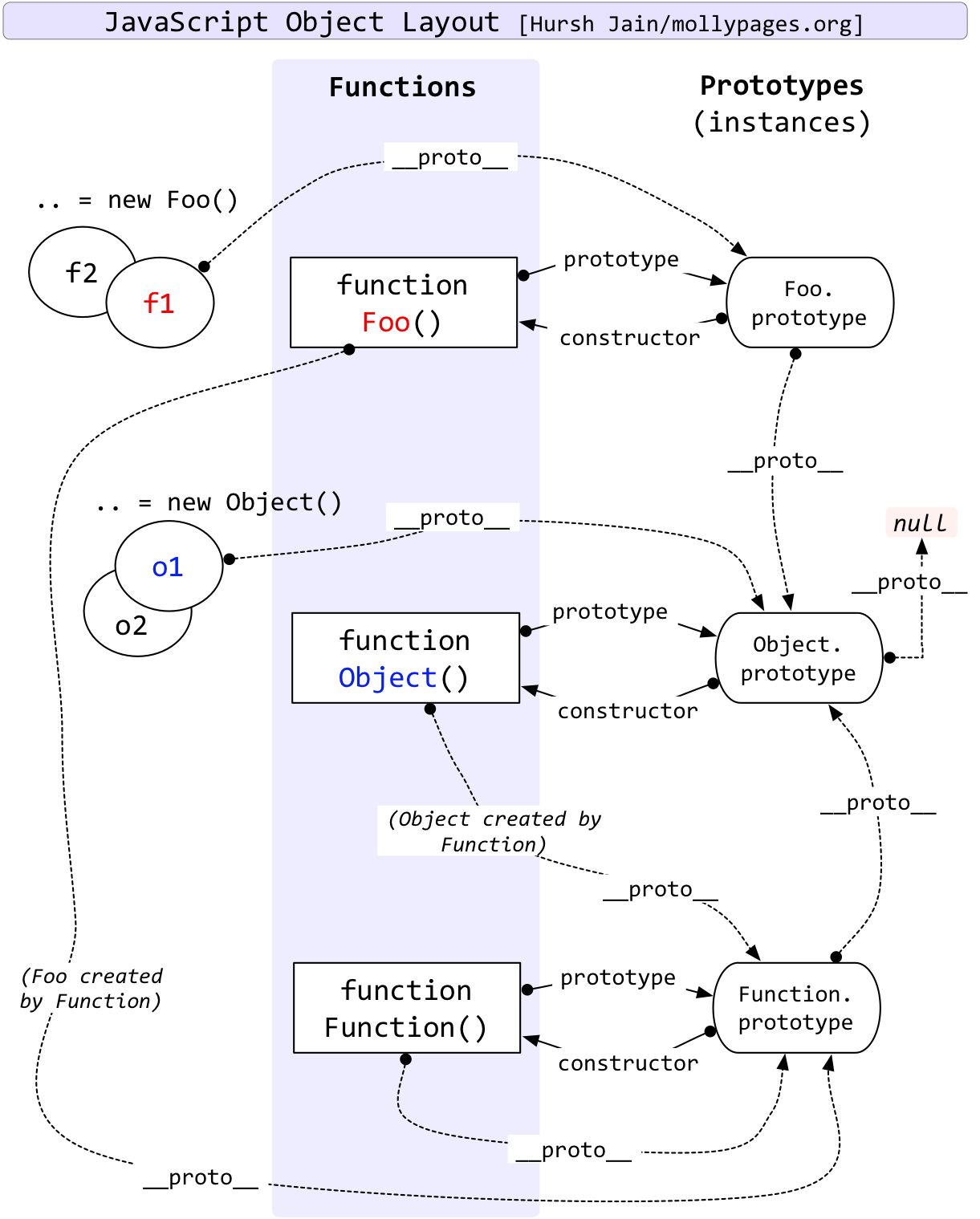
原型继承 实现 1 2 3 4 5 6 7 8 9 10 11 12 13 14 15 function SuperType (this .property = true ;SuperType .prototype getSuperValue = function (return this .property ;function SubType (this .subproperty = false ;SubType .prototype new SuperType ();SubType .prototype getSubValue = function (return this .subproperty ;let instance = new SubType ();console .log (instance.getSuperValue ())
缺点
实例属性最终变成了原型属性,被所有实例共享
子类在实例化时,不能给父类的构造函数传参
盗用构造函数 实现 1 2 3 4 5 6 function SuperType (this .colors = ['red' , 'blue' , 'green' ]function SubType (SuperType .call (this );
缺点
无法访问父类原型上的方法,只能将方法定义在构造函数中
组合继承 实现 1 2 3 4 5 6 7 8 9 10 11 12 13 14 15 16 17 function SuperType (this .colors = ['red' , 'blue' , 'green' ]SuperType .prototype getName = function (console .log (this .colors )function SubType (age ) {SuperType .call (this )this .age = age;SubType .prototype new SuperType ()SubType .prototype getAge = function (console .log (this .age )
缺点
原型式继承 实现 1 2 3 4 5 6 7 function object (o ) {function F (prototype return new F ()let other = Object .create (o)
寄生式继承 实现 1 2 3 4 5 6 7 function createAnother (o ) {let clone = Object .create (o)sayHi = function (console .log ('hi' )return clone
缺点
寄生式组合继承 实现 1 2 3 4 5 6 7 8 9 10 11 12 13 14 15 16 17 18 19 20 21 22 function inheritPrototype (subType, superType ) {let prototype = Object .create (superType)constructor = subTypeprototype function SuperType (this .colors = ['red' , 'blue' , 'green' ]SuperType .prototype getName = function (console .log (this .colors )function SubType (age ) {SuperType .call (this )this .age = age;inheritPrototype (SubType , SuperType )SubType .prototype getAge = function (console .log (this .age )
类 类定义 定义 1 2 3 4 5 6 7 8 9 10 class Person {}const Animal = class {}let Person = class PersonName {let p = new Person ()console .log (Person .name ) console .log (PersonName )
特点
类构造函数 实例化
在内存创建一个新对象
对象内部的[[Prototype]]指针被赋值给构造函数的prototype属性
构造函数内部的this被赋值为这个新对象
执行构造函数的代码
如果构造函数返回非空对象,则返回该对象,否则,返回刚才新建的对象
继承 定义 1 2 3 4 5 6 class Vehicle {}class Bus extends Vehicle {constructor (super ()
特点
super只能在构造方法和静态方法中使用
不能单独引用super关键字,console.log(super)会抛出错误
没有定义构造函数时,在实例化子类会调用super(),并且传入所有传给子类的参数
类构造函数中,不能在调用super()之前调用this
子类中显示定义了构造函数,则必须在其中调用super(),或者返回一个对象
类混入 extends后面是一个JavaScript表达式,任何可以解析为一个类或者构造函数的表达式都是有效的
1 2 3 4 5 6 7 8 9 10 class Vehicle {}let FooMixin = (Superclass ) => class extends Superclass {foo (let BarMixin = (Superclass ) => class extends Superclass {bar (class Bus extends FooMixin (BarMixin (Vehicle )) {
参考链接 [1] http://www.mollypages.org/tutorials/js.mp